- Scientific Area
- Dermatologic surgery
SCIENTIFIC AREA
Dermatologic Surgery
- DEFINITION
Dermatologic surgery is an integral and fundamental component of Dermatology.
It is performed by Dermatologists, i.e. doctors specialized in dermatology, who have been trained to acquire specific surgical skills.
Dermatologic Surgery can be considered as that part of Dermatology Specialty focusing on diagnosing, treatment, prevention and patients education on conditions affecting skin, nails, hair, skin glands, requiring minimally to moderately invasive surgical procedures, on cosmetic skin surgery procedures and on skin treatment procedures assisted by lasers, light sources and energy-based devices.
Dermatologic Surgery comprises strictly curative procedures, like removal of skin cancers, as aesthetic procedures, to solve or enhance cosmetic problems, mostly in combination with medical therapy.
Most Dermatologic Surgery procedures are performed on an outpatient basis under local anesthesia, faster recovery times and maximum convenience.
When and WHY choosing a Dermatologic surgeon?
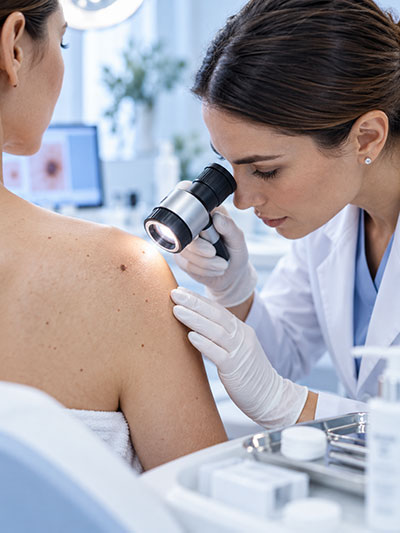
The Dermatologist is a medical doctor trained to read and properly understand the complex and variegated features and symptoms of the skin, based on clinical signs and relying on special diagnostic tools, as dermoscopy, confocal and optical coherence microscopy, high frequency ultrasonography, histology and micrographic surgery.
After an appropriate skin evaluation and a consistent diagnosis, the Dermatologic surgeons are trained to implement cutaneous surgery as an integral part of the care program of their patients, regarding pathological as well as aesthetic skin conditions.
Mohs micrographic surgery is a special surgical and intra-operative diagnostic procedure based on microscopy – controlled skin tumors removal, allowing a high rate of complete removal in comparison to traditional surgical techniques, a more accurate definition of tumor margins, with a greater saving of otherwise healthy surrounding tissues.
After removing the skin tumor, a very important part of the Dermatologic Surgeon competence is the project of an appropriate reconstruction of the surgical defect, with the minimally visible scars, minimal aesthetic impact and functional consequences for the patient.
Dermatological surgery is also aimed at the corrective treatment of blemishes that are not sensitive to cosmetic creams or medical therapies, often using advanced methods and therapeutic tools based on high-tech medical devices, as lasers, intense light sources, various kinds of energy based devices ad combinations of treatments. The dermatologic surgeon has a cultural background to master the field of aesthetic medicine in skin
treatments.
Thanks to his knowledge of anatomy and the physiology of the skin, he is able to understand the complex interactions that occur in the patient’s skin when performing an aesthetic treatment as when dealing with a skin disease or tumor.
- CORE ELEMENTS CONSISTENTLY EMPHASIZED BY MAJOR DERMATOLOGIC SOCIETIES
The scopes of Dermatologic Surgery
The scopes of Dermatologic Surgery based on scientific evidences and stated my most relevant scientific societies in Dermatology converges on several pillars
01
Diagnostic skin surgery
Procedural diagnosis and skin biopsies of skin disease and tumors is a daily routine in the
Dermatology office
02
Oncologic dermatologic surgery
Treatment of benign, premalignant, and malignant skin tumors, including melanoma and nonmelanoma
skin cancers;
Mohs micrographic surgery is a central component of the modern approach to most skin tumors
03
Reconstructive surgery
Aims at closure of the surgical defect and repair after tumor excision, preserving anatomy and function and minimizing cosmetic impairment and aesthetic impact of the procedure.
04
Procedural/minimally invasive dermatology
Cryosurgery, electrosurgery, curettage, lasers, scar revision, nail surgery, vascular or vein procedures.
05
Aesthetic/corrective dermatologic procedures
Depending on the local preferences and regional social framework, Aesthetic Dermatology includes botulinum toxin, fillers, laser resurfacing, chemical peels, hair restoration, liposuction,
laser and energy based skin treatments, vein treatments, and other appearance-oriented interventions performed within dermatologic expertise.
The scopes of Dermatologic Surgery
A visit to a dermatologic surgeon may be preferable to other specialists when the problem is primarily cutaneous and requires a combination of diagnostic accuracy, tissue-preserving surgery, pathologyoriented thinking, and cosmetic/functional reconstruction.
A synthesis of the literature and major dermatologic society positions would justify referral to a Dermatologic Surgeon on several grounds:
1 – Disease-specific expertise in skin biology
A Dermatologic Surgeon is first a Dermatologist with advanced procedural/surgical training.
Dermatologists are medical doctors trained to recognize subtle distinctions among inflammatory, infectious, benign, premalignant, and malignant skin diseases before operating.
This diagnostic depth can reduce unnecessary surgery and improve lesion selection.
2. Superior specialization for skin tumors
For skin cancers (especially facial or recurrent tumors), dermatologic surgeons frequently provide:
- more precise clinical diagnosis
- more precise margin control,
- tissue-sparing techniques,
- expertise in high-risk anatomical sites (eyelids, nose, lips, ears),
- and integrated reconstruction.
This is especially true in settings involving Mohs micrographic surgery, where cure rates for selected nonmelanoma skin cancers are very high while preserving maximal healthy tissue.
3. Better cosmetic and functional outcomes in visible areas
Skin surgery is unique because outcomes are judged not only by cure but also by:
- scar quality,
- preservation of movements,
- maintenance of facial units and symmetry,
- texture and pigment matching.
Dermatologic surgeons often perform a high volume of procedures on cosmetically sensitive areas and are specifically trained in scar minimization and cutaneous reconstruction.
Examples where this matters:
- eyelids,
- nose,
- lips,
- ears,
- genital skin,
- nail unit surgery,
- scalp and hair-bearing areas.
4. Integration of surgery with non-surgical dermatology
Unlike many surgical specialists, a dermatologic surgeon can move seamlessly between:
- medical treatment,
- skin biopsy and diagnosis,
- surgical treatment,
- laser/energy-based approaches,
- follow-up surveillance.
A patient may receive the least invasive effective treatment rather than defaulting to surgery.
5. Office-based, minimally invasive care
Many procedures can be performed:
- under local anesthesia,
- in outpatient settings,
- with lower procedural burden,
- and faster recovery.
This is particularly relevant for older patients or those with co-morbidities.
When another specialist may be preferable
A dermatologic surgeon is not always the best first choice. Other specialists may be preferable when:
- Deep soft tissue, muscle, tendon, or nerve involvement → plastic, maxillofacial, orthopedic, or general surgery.
- Large complex reconstruction → plastic surgery.
- Advanced tumors requiring lymph node surgery → surgical oncology.
- Purely cosmetic facial structural procedures (deep lifting, rhinoplasty) → plastic or maxillo-facial plastic surgery.
Stay connected with ISDS
Get the latest news, events and educational opportunities.