
- Scientific Area
- Dermatologic surgery
SCIENTIFIC AREA
Laser, Light Sources, Energy Based Devices
Dermatologists can be a particularly strong choice for treating skin conditions with lasers, IPLs, LEDs, and other energy-based devices because of their training in skin biology, disease diagnosis, procedural medicine, and complication management.
Whether they are the superior choice depends on the condition and the practitioner’s expertise, but there are several reasons why dermatologists—especially dermatologic surgeons and laser dermatologists—are often uniquely positioned.
- 1. They are physicians specialized in skin disease
- 2. They understand skin optics and laser–tissue interaction
- 3. They are trained to diagnose before treating
- 4. Dermatologists can integrate devices with medical therapy
- 5. Better ability to prevent and manage complications
- 6. Strong expertise in medically indicated laser procedures
- 7. Dermatologic surgeons often have advanced procedural training
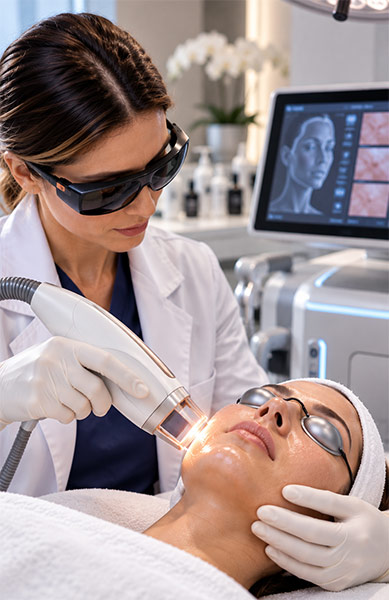
1. They are physicians specialized in skin disease
A dermatologist is a physician whose entire specialty focuses on skin, hair, nails, and mucosa. This matters because lasers and energy devices are not simply “cosmetic tools”—they are medical treatments that interact with diseased or healthy skin.
Dermatologists are trained to distinguish:
benign lesions from malignant ones,
inflammatory diseases from pigment or vascular disorders,
scarring, vascular, infectious, and neoplastic conditions that can mimic one another.
For example, a pigmented lesion that appears cosmetic may actually require biopsy before laser treatment because it could represent melanoma or another malignancy.
Treating undiagnosed lesions with lasers may delay diagnosis significantly.
2. They understand skin optics and laser–tissue interaction
Modern laser medicine requires understanding:
chromophore targeting (melanin, hemoglobin, water, fat),
wavelength selection,
pulse duration and thermal relaxation time,
fluence, spot size, and cooling,
skin phototype–specific risks.
Dermatologists receive dedicated education in cutaneous laser physics and photomedicine, particularly during procedural fellowships or advanced training.
Examples:
Choosing between vascular lasers, IPL, or radiofrequency for rosacea versus telangiectasia.
Selecting fractional ablative vs non-ablative resurfacing for scars.
Adjusting settings for darker phototypes to reduce risk of post-inflammatory hyperpigmentation.
3. They are trained to diagnose before treating
Lasers, medical light sources and energy-based treatments are most effective when diagnosis is correct. A dermatologist can distinguish whether “redness” is:
acne,
rosacea,
lupus,
steroid dermatitis,
photodamage,
vascular malformation.
Likewise, “pigmentation” could reflect:
melasma,
lichen planus pigmentosus,
post-inflammatory hyperpigmentation,
ochronosis,
lentigo maligna.
The same device can help one condition and worsen another.
4. Dermatologists can integrate devices with medical therapy
Many skin conditions are multimodal and not best treated with devices alone.
Examples:
Acne scars → lasers + topical retinoids + subcision + fillers.
Melasma → pigment suppression + sun protection + cautious device use.
Hair loss → LEDs or energy devices + pharmacologic therapies.
Actinic damage → field therapy + photodynamic therapy + resurfacing.
Dermatologists can prescribe medications and coordinate comprehensive treatment plans.
5. Better ability to prevent and manage complications
All energy-based procedures carry intrinsic risks:
burns,
dyspigmentation,
scarring,
infection,
paradoxical hair stimulation,
granulomas,
delayed healing,
reactivation of herpes simplex.
Dermatologists are trained to recognize and manage properly adverse cutaneous reactions quickly and medically.
For example:
distinguishing post-laser erythema from infection,
treating laser-induced hyperpigmentation,
recognizing contact dermatitis from post-procedure products,
managing scar prevention early.
6. Strong expertise in medically indicated laser procedures
Dermatologists routinely use lasers and energy devices for medical, not only cosmetic, indications:
vascular lesions (hemangiomas, telangiectasia),
scars and keloids,
acne and acne scarring,
inflammatory dermatoses,
pigment disorders,
photodamage,
premalignant lesions,
hidradenitis suppurativa,
nail disease,
hair disorders,
selected skin cancers and precancers.
LEDs and photobiomodulation are also increasingly used as adjunctive therapies in wound healing, inflammatory disorders, alopecia, and rejuvenation.
7. Dermatologic surgeons often have advanced procedural training
Some dermatologists pursue focused training in:
laser surgery,
Mohs and reconstructive surgery,
cosmetic dermatology,
procedural dermatology.
These physicians often manage the widest range of laser platforms and difficult cases, including complications and patients with complex medical skin disease.
Important nuance: specialty alone does not guarantee expertise: A highly experienced laser dermatologist may be preferable for many skin disorders, but the best predictor of outcome is often specific training and experience, not only specialty title.
Key questions for any provider:
What formal training in lasers/energy devices do they have?
How many similar cases do they treat?
Do they treat your specific skin condition?
Can they manage complications?
Do they offer a diagnosis-driven treatment plan?
For skin disease, especially when diagnosis is uncertain, pigment is involved, there is scarring risk, darker phototypes, or medical complexity, dermatologists often have a meaningful advantage because they combine diagnostic dermatology, procedural skill, and medical management of the skin.
Stay connected with ISDS
Get the latest news, events and educational opportunities.