- Scientific Area
- Dermatologic surgery
SCIENTIFIC AREA
Complex or Advanced Skin Cancers
Why Dermatologic Surgery?
Dermatologic surgeons are key specialists in the management of complex, high-risk, locally advanced, and selected metastatic skin tumors, especially when treatment requires a combination of surgery, reconstruction, pathology, imaging, and multidisciplinary oncology care.
For complex or advanced skin tumors, the role of dermatologic surgeons extends far beyond simple excision.
- 1. Risk stratification and diagnostic staging
- 2. Precision tumor removal with complete margin control
- 3. Surgical management of locally advanced disease
- 4. Reconstruction after tumor removal
- 5. Coordination of multidisciplinary oncologic care
- 6. Integration with modern systemic therapies
- 7. Long-term surveillance and prevention
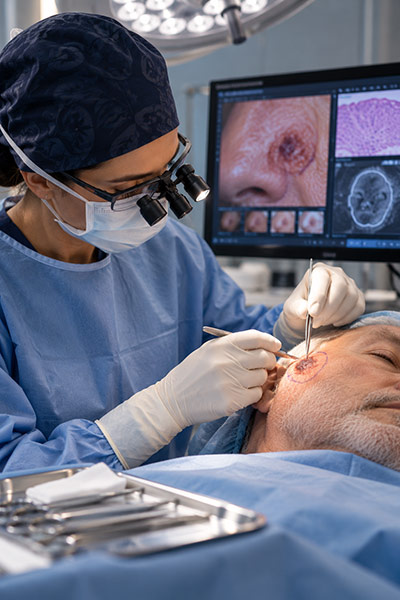
1. Risk stratification and diagnostic staging
Dermatologic surgeons assess whether a tumor is high-risk or advanced, considering factors such as:
Tumor size and depth
Aggressive histologic subtype
Perineural invasion
Recurrent disease
Poorly defined margins
Location in high-risk areas (face, ears, eyelids, nose, lips, genital region, hands)
Immunosuppression or genetic cancer syndromes
Nodal or distant spread suspicion
They often coordinate:
Advanced dermoscopy and imaging
Histopathologic review
Biopsy mapping for large or multifocal lesions
Staging work-up when indicated (e.g., ultrasound, CT, MRI, PET in selected tumors)
This is particularly important for high-risk:
Cutaneous squamous cell carcinoma
Basal-cell carcinoma
Melanoma
Merkel-cell carcinoma
Rare adnexal tumors and cutaneous sarcomas
2. Precision tumor removal with complete margin control
For many advanced tumors, dermatologic surgeons use microscopically controlled surgery, particularly: Mohs micrographic surgery
This technique allows:
Complete examination of 100% of surgical margins
Maximal tissue preservation
Higher cure rates for difficult tumors
Better functional and cosmetic outcomes
It is especially valuable for:
Large facial tumors
Recurrent cancers
Aggressive histologic variants
Tumors with indistinct borders
Tumors near critical structures (eyelids, nose, lips, nerves)
For advanced tumors, Mohs surgery may involve:
Multiple stages
Immunostaining techniques
Frozen section interpretation
Collaboration with pathology
In some cases, surgeons perform slow Mohs/paraffin-controlled excision, especially for melanoma in situ, lentigo maligna, or rare tumors requiring permanent sections.
3. Surgical management of locally advanced disease
Dermatologic surgeons often treat tumors that invade:
Deep dermis
Subcutaneous tissue
Cartilage
Muscle
Fascia
Periosteum
This may require:
Wider oncologic resections
Staged surgery
Debulking before systemic therapy
Complex closure strategies
For selected advanced cases, they may help determine whether surgery is still feasible or whether neoadjuvant systemic treatment should come first.
Examples:
Large neglected facial SCC
Giant BCC with orbital or cartilage invasion
Extensive field cancerization
Tumors in frail or elderly patients where tissue preservation matters greatly
4. Reconstruction after tumor removal
One of the defining strengths of dermatologic surgeons is that they usually perform same-day reconstruction after oncologic clearance.
They reconstruct defects using:
Primary closures
Skin grafts
Local flaps
Interpolation flaps
Cartilage grafting
Multilayer reconstruction
Goals include:
Functional preservation (vision, speech, breathing, eating)
Facial symmetry
Aesthetic restoration
Minimal morbidity
Complex facial reconstruction is especially important after tumors involving:
Nose
Eyelids
Lips
Ears
Scalp
5. Coordination of multidisciplinary oncologic care
Advanced skin cancer increasingly requires a tumor board approach, and dermatologic surgeons often coordinate or participate in multidisciplinary care with:
Surgical oncology
Head and neck surgery
Plastic surgery
Oculoplastic surgery
Medical oncology
Radiation oncology
Dermatopathology
Radiology
This is particularly relevant for:
Node-positive SCC
High-risk melanoma
Metastatic disease
Perineural spread
Immunosuppressed patients
6. Integration with modern systemic therapies
Modern dermatologic surgeons increasingly integrate surgery with systemic treatments such as:
For advanced BCC:
Vismodegib
Sonidegib
For advanced SCC and melanoma:
Immune checkpoint inhibitors such as:
Cemiplimab
Pembrolizumab
Nivolumab
Surgery may be used:
Before systemic therapy
After tumor shrinkage
For residual disease
For palliation
To obtain tissue for molecular diagnosis
7. Long-term surveillance and prevention
Patients with advanced skin tumors are at high risk of recurrence and second cancers. Dermatologic surgeons oversee:
Intensive follow-up
Scar monitoring
Detection of recurrence
Management of field cancerization
Prevention strategies
Treatment of precancerous lesions
Why Dermatologic Surgeons Are Particularly Suited for Advanced Skin Tumors
The expertise of an ontologically oriented dermatologic surgeon sits at the intersection of:
Dermatology + oncology + pathology + surgery + reconstruction
Unlike many specialties, Dermatologic Surgeons are specifically trained to:
Diagnose skin tumors clinically and dermoscopically
Interpret histopathology in surgical context
Remove tumors with complete margin control
Reconstruct complex defects
Coordinate long-term cutaneous cancer surveillance
For many complex facial skin cancers, especially recurrent or high-risk tumors, dermatologic surgeons are often the specialists best positioned to lead care or co-lead it within a multidisciplinary oncology team (skin tumor board).
Stay connected with ISDS
Get the latest news, events and educational opportunities.